Why try to change me now?

You probably have heard that Bob Dylan was recently awarded the Nobel prize for literature. You might also be aware that he has yet to officially acknowledge it.

At this point, it doesn’t seem likely he will turn up at the ceremony in Stockholm to receive the award. And if I were a betting person, I’d wager he won’t do the lecture that is a condition of receiving the $900,000 payout.

The powers that be at the Nobel Foundation are apparently aghast at Dylan’s silence, which one member deemed “rude and arrogant.”

Of course, this is all just Bob being Bob.

The other night Dylan performed a 90 minute concert in Oklahoma. He didn’t acknowledge the crowd when he took the stage and didn’t say “goodbye” at the end of the set. He didn’t pick up a guitar, but instead played piano most of the night. He didn’t introduce the band. There was no banter in between songs.

Just Bob being Bob.

Now there are a few things we know about change. Among them is the plain and simple fact that you can’t change someone who doesn’t want to change. Another is that we are only motivated to change when what we are doing no longer works for us.

Despite the protestations of the Nobel folks-and the broader lamentations of the public–I’m guessing a change is not going to come.

Perhaps it’s just a coincidence, but it turns out Dylan has been closing recent sets with this.

American Masters: Bob Dylan

Where have all the blacksmiths gone?

For quite a long time being a blacksmith was a pretty good gig. Creating tools and other items from metal, as well as repairing them, was in solid demand for centuries. And, as it turns out, learning to forge, draw and bend wrought iron, bronze or steel is no easy task.

As we moved through the 20th century being a blacksmith didn’t get much easier. Sure, there were some technological advances but, by and large, it was a craft that required considerable skill and perseverance.

You might have noticed that aren’t many blacksmiths around these days. In fact, my guess is you’ve never even seen a working blacksmith shop (though you might know a hipster or two who have taken it up as a hobby).

Of course, the blacksmiths didn’t disappear all at once. But as new technology and substitutable products emerged–and began to achieve widespread adoption–the demand for blacksmiths waned. Eventually, the once common vocation became an anachronism.

I’m left to wonder how many blacksmiths saw it coming? How many realized they were doomed to extinction? And if they had that foresight, how many had the fortitude to let go of their once tried and true identity to forge (heh, heh) a new path?

I also wonder who are today’s blacksmiths? Could it be me? Could it be you?

And if it were, do we have the courage to leap into something new?

are-you-a-blacksmith


The power of now. The power of no.

“Life is a series of moments, all called ‘now’.”      

– Unknown

“When you say ‘yes’ to others, make sure you are not saying ‘no’ to yourself.”

– Paulo Coelho

If you are anything like me, it’s often pretty easy to slip into a little time traveling–to lament what might have been or too worry about what the future holds. Unfortunately I lack both a time machine and the gift of prophecy, so this is not only a big waste of time, it can very easily mess with the serenity I desire.

If you are anything like me, you might find yourself frequently saying “yes” to things you really shouldn’t–perhaps out of a desire to look like a good person, to avoid hurting the other person’s feelings or merely because you struggle to trade off the essential against the expected or habitual. And then the resentment and self-shaming follows as we realize how our wants and needs once again take a back seat to the squeaky wheel or the self-inflicted obligation.

We can dream about having super-powers, but eventually reality rears its ugly head. And we can work hard to accept all the things we are powerless over (spoiler alert: it’s just about everything). But when it comes down to it, two “powers” can make a huge difference.

The power of now: the commitment to live fully in the present moment and to let go of the past we cannot change and the future we can neither predict, nor control.

The power of no:  the willingness to stop saying “yes” to obligations, mindless distractions, bad relationships and everything else that gets in the way of our living a life of purpose, connection and fulfillment.

be-here-now

The amount of work is the same

“We either make ourselves miserable, or we make ourselves happy. The amount of work is the same.” —Carlos Castaneda

Of course this is true of many things . . .

Encountering the world from the wound of hate or from the warmth of love.

Furiously protecting our ego or opening to connection.

Lamenting the past, worrying about the future or living in the present moment.

Fighting reality or choosing acceptance.

Constraining ourselves to the known or widening to an infinite field of possibilities.

Living in fear or cultivating peace.

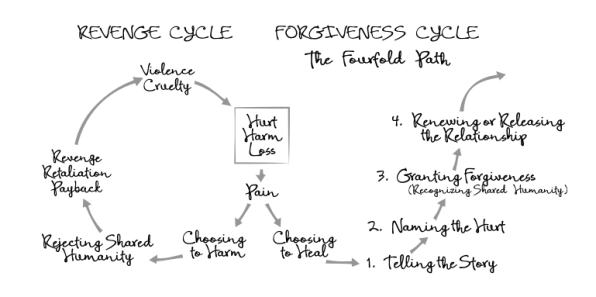
Perpetuating the cycle of revenge or engaging in forgiveness.

Anytime we tell ourselves we don’t have a choice, we are lying.

Choose wisely. It matters.

forgivness-cycle

The scorpion, the frog and the Donald

Perhaps you know the fable…

A scorpion and a frog meet on the bank of a stream. The scorpion asks the frog to carry him across on its back. The frog asks, “how do I know you won’t sting me?” The scorpion says, “because if I do, I will die too.”

The frog is satisfied and they set out, but in midstream, the scorpion stings the frog.

The frog feels the onset of paralysis and starts to sink. Now knowing that they both will drown, he musters up enough strength to gasp “but why?”

The scorpion replies: “It’s in my nature.”

When new information is revealed, shock and indignation are totally appropriate. But when someone does some slightly different version of what they always do, why would we be surprised?

Instead, we should dig deep on how and why we allowed that level of unconciousness to arise.

6a00d8341caebd53ef019b02318eaa970d

It’s later than you think

Last year a close friend of mine died tragically and unexpectedly–though I suppose every death is a tragedy, anticipated or not.

He was only in his early forties, with a lovely family and a thriving business he had built from scratch after having the courage to make a major career shift more than a decade ago. In his chosen new profession he profoundly touched the lives of dozens, if not hundreds, of people. He generously and compassionately helped people at a level that’s impossible (at least for me) to explain.

What I know for certain is that he was essential to my getting through two extremely difficult periods during the past few years. In fact, he may very well have saved my life–for which I shall be eternally grateful.

In my mix of grief and gratitude two important lessons emerged.

First, and most obviously, depression is a very real and serious issue for so many people, and our tendency to look away or to minimize–or to label sufferers as “weak” or “lazy”– is not only wrong, it’s hurtful.

The second is that it’s later than we think.

The notion that things will unfold the way we want, at a time and date largely of our choosing, sits somewhere between utter delusion and misguided fantasy. The idea that I will be better able to start the important stuff tomorrow–or, better yet, maybe next week once things settle down at work–is just one of the oft-repeated lies I tell myself.

Things are often moving faster than they seem. We have to expect the unexpected. And whether we like it or not, at some point the clock stops in some way, shape or form on everyone and everything…

…the window to launch that new business

…the time to write the book we’ve been talking about for ages

…the opportunity to forgive

…the ability to shift from fear, anger and revenge to open-heartedness and compassion

…the space to tell someone what they’ve meant to you

…the chance to say “I love you.”

In so many ways it’s later than we think. And my guess is that we all have plenty of catching up to do.

Living a life of meaning and purpose in the present moment is ultimately the only choice we have.

now-time

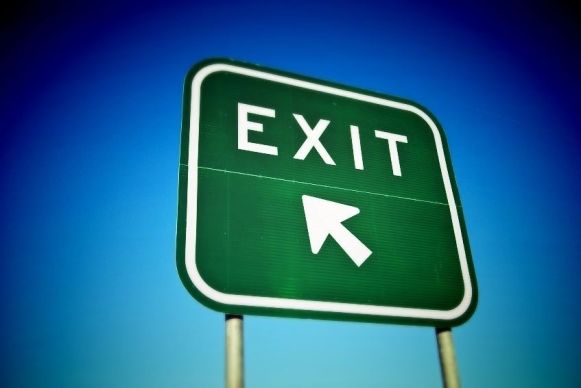
The exits are clearly marked

Maybe we’re in a relationship, romantic or otherwise, that has become highly dysfunctional but we’re too afraid to leave for fear of being alone or hurting the other person’s feelings.

Maybe we’re in a job where personal growth has long since ceased or our contributions are not well appreciated, yet the thought of making a major career shift virtually paralyzes us.

Maybe we’re a long-time member of a group that has drifted from its original purpose or lost its ability to make things happen, but we feel an obligation to try to fix it even when we know it’s neither possible, nor the best use of our scarce time and energy.

Maybe we get behind a leader “for the good of the cause” but come to see that the behaviors that rub us the wrong way–or we feel compelled to disavow completely–are revealed to be his deeply held beliefs and character defects.

Our heart usually tell us it’s time to get out way before our brain does its more careful and deliberate work.

When we let go of the past, the need to be right, the worry about what others might think –and the somewhat pathological urge to fix everything–our burden is lightened and our path becomes far more clear.

The exits are clearly marked.

The challenge is to muster up the courage to walk out the door.

exit1

Learning to surf

There are a few different ways people approach the ocean.

Some dive right in.

Others inch in slowly, testing the temperature of the water until they feel comfortable to wade in all the way.

A few like to stand there and get pummeled by the water’s force.

And of course there are those that avoid going to the beach entirely.

The most daring and remarkable of all are the surfers.

The surfer harnesses the ocean’s power, gliding above the surface, zigzagging their way to the shore. Of course, sometimes they fall off their board. But the good ones understand this is just part of the process and hop right back on. They know that through practice they will navigate the inevitable ebbs and flows, the unexpected surge, the occasional fellow competitor that gets too close. Over time, they spend more time up on the board, reaching the shore faster with far more grace and power then when they started.

They understand and accept a few things we all should.

Avoiding turbulent water is impossible.

Fighting the power of the ocean is an exercise in futility.

Waves are inevitable.

We’re going to have to learn how to surf.

And the hardest part is paddling out in the first place.

943d0da1506187984d126b19b3ca0c62

An unexamined faith

“An unexamined faith is not worth having, for it can be true only by accident.”

James Luther Adams

Reason and faith are not polar opposites, nor are they mutually exclusive.

Reason and faith are not in constant battle, though it may often seem that way.

Reason does not have a monopoly on thought. Faith is not the sole province of intuition.

Reason isn’t just about science and law. Faith is not only a religious concept.

Even the most “reasonable” and left-brained among us exhibit plenty of faith.

Don’t believe me? Make a list of the things that you are convinced are true even if there is no objective basis to have that conclusion.

It may be as simple as believing that the Cubs will win the World Series. It may be as complicated as thinking your view of how the universe came to be is the right one.

It may be as deep as your faith that things always happen for a reason. It may be as shallow as your conviction that something you just bought will make you happy.

Reason is not strong. Faith is not weak. They not only can co-exist, they can be mutually reinforcing.

Faith is not the problem. Blind faith is.

When we accept that something is true without a level of true understanding, without discrimination, without going deep into our intentions, we risk making those that believe differently “the other.”

Indeed, we risk making the certitude of our faith a weapon.

photo_adams-copy

Books about heaven

Perhaps you’ve seen the legendary New Yorker magazine cartoon that depicts a man standing before two doors, seemingly perplexed. One door is labeled “Heaven” and the other is labeled “Books About Heaven.”

Pick just about any cause we claim to be passionate about. Happiness. Innovation. Social justice. Immigration reform. Climate change. Being a better parent. Eating more healthfully. Whatever floats your boat.

If you are anything like me, it’s often easier to be getting ready to go do something meaningful rather than wholeheartedly embrace that thing I claim to desperately want.

If I think things through thoroughly, I tell myself, the outcome I want will be assured. If I research just a little bit more, I will be perfectly prepared when the time is right.

But there is no perfect time.

We always have to start before we are ready.

We have to do the work, rather than just study the work.

If we want to swim, we need to get wet.

Our own version of heaven is here right now, in this present moment, if we are willing to just see it, accept it and embrace it fully.

We can always be in pursuit of happiness or–and here’s a crazy idea–we can actually try being happy.

Jump in. The water is fine.

quote-do-you-want-to-understand-how-to-swim-or-do-you-want-to-jump-in-and-start-swimming-only-michael-crichton-41-33-11

This post is adapted from one that originally appeared at http://www.stevenpdennis.com