Welcome to the failure conference

“Vulnerability is the birthplace of innovation, creativity and change”  – Brene Brown

I hope you are familiar with the work of Brene Brown. Brene is a shame researcher and the author of several great books on the power of vulnerability and the gifts of imperfection. She’s delivered two of the most popular TED talks of all time. She’s been on Oprah. She’s helped me change my life. Yeah, she’s kind of a big deal.

In her most recent TED talk, one of the many powerful things Brene said was this:

“You know what the big secret about TED is? I can’t wait to tell people this. I guess I’m doing it right now. (Laughter) This is like the failure conference. No, it is. (Applause) You know why this place is amazing? Because very few people here are afraid to fail. And no one who gets on the stage, so far that I’ve seen, has not failed. I’ve failed miserably, many times. I don’t think the world understands that because of shame.”

When I headed up strategy & innovation at a large retailer several years ago, I had a one-on-one session with the CEO to discuss a new venture my team was just starting work on. Maybe two minutes into our meeting he paused dramatically, looked at me very seriously and said “Steve, here’s the thing. We can’t fail. We can’t afford another (and here he mentioned a failed store concept from years ago which, as an aside, was doomed from the start by a number of bone-headed decisions). I don’t want to take any risk. None. Do you understand?”

Yeah, I understood. I was screwed. We were screwed. Needless to say, innovation, creativity and change were hardly the hallmarks of our culture during that time and any progress we made was, shall we say, not so easily won.

If you are committed to innovation, you are signing up for failure. It’s not being reckless, but it is accepting that failure comes with the territory. The key is not to never fail, the key is to fail better.

If you are committed to creativity, you are vulnerable to criticism. Any time you put something really new out into the world and say “here I made this” judgment (and perhaps outright hatred) is bound to follow. It can’t stop you.

If you are committed to meaningful change, you are almost certain to be walking straight into gale force headwinds. Vested interests and defenders of the status quo will fight you at every turn. Stay the course. In fact, perhaps it’s time to step on the gas.

It’s taken me a long time to learn this lesson–and frankly I still fight the battle every single day–but I know I do my best work when I push through my fear, when I allow myself to be vulnerable, when I accept that failure is inherent to any growth process.

I hope to see you at the next failure conference. Let’s sit right down front where everyone can see us.


Screen-Shot-2014-01-26-at-12.44.35-1024x760

The struggles of the flying trapeze artist

If only growth–profound, meaningful growth–personal, business or otherwise, could happen without confronting our fears and was devoid of any risk, absent any real struggle or pain.

Wouldn’t it be great if the journey from a challenging present set of circumstances to a robust, inspiring future could skip over the whole vulnerable and disquieting parts? Wouldn’t it be wonderful if we could retain the warm comfort of doing what we’ve always done while still getting the benefits of all this new stuff we tell ourselves we need to do?

But once we get serious about change, once we are ready and committed to do the work, our struggles are akin to those of flying trapeze artists.

The trapeze artist climbs up that ladder and takes a position high above the safety of terra firma.

The trapeze artist must accept the risk that she might fall.

The trapeze artist then courageously leaps off the platform, leaving stability and security behind.

The trapeze artist then works on timing and coordination and building up the right speed.

And then she has to let go of what’s she been holding on to and have the faith that there will be something to grab hold of to support her and to propel her forward.

As Seth reminds us, there are no timid trapeze artists and you can’t get to the next rope if you’re still holding on to this one.

trapeze-2

Quitting is underrated

We don’t have to spend much time among our friends or on social media to run across the never give up, quitting is for losers, in-it-to-win-it ethos. There’s a whole socially acceptable narrative built around the notion that only weak people quit and that failure is never an option.

It’s ridiculous. It’s wrong. And it’s harmful.

Perseverance, grit, determination and hard work are certainly important to achieving our goals. But frequently our best work–the work that matters, disrupts, challenges the status quo–comes precisely because failure IS an option. It happens when we know “this might not work” and we choose to do it anyway.

Yet the best friend of an intentional choice to go out on a limb and take a risk is knowing when it’s time to quit. The point is not to avoid failure at all costs, the point is to fail better. Failing better means failing faster and failing smarter. It means knowing when to stop pushing too big of a rock up too big of a hill. It’s radical acceptance of reality. It means being vulnerable to the idea that despite our best efforts, despite what our original analysis told us, despite knowing that we might hurt someone else’s feelings, despite the real possibility of looking stupid, we simply need to stop.

I loved it when, in her now classic talk on shame, Brene Brown referred to TED as the “failure conference.” She called out the reality that all these great leaders and speakers we look up to had dared greatly and failed–many of them on more than one occasion. It was, in fact, a room chock-a-block with quitters. But not quitters who beat themselves up about it and became victims. They were all quitters who had indeed failed better. They eventually figured out when it was time to stop, learned from their mistakes and moved on.

It turns out that knowing when –and having the courage–to quit is exactly what frees us up to go and try the next big thing.

I wonder what we are all doing right now that’s worth quitting?

I wonder if we can muster up the courage to stop and simply say “no more.”

I wonder what amazing possibilities that will unleash.

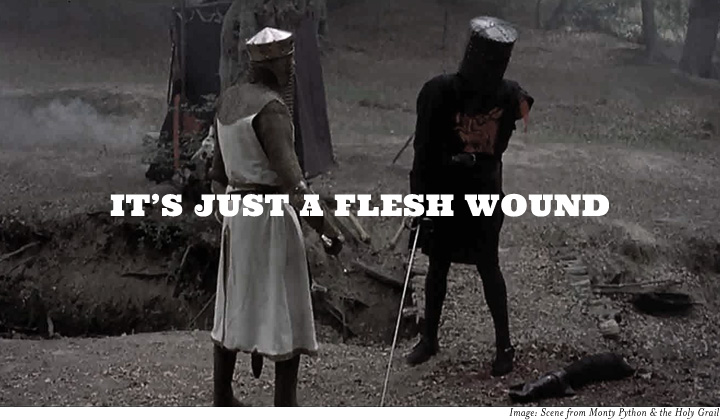
fleshc

This post originally appeared at http://www.stevenpdennis.com  Brand new content will appear on this new blog very soon.

Grey is my favorite color

I know a lot of people who see the world in black and white. And I love you, I really do. I am a recovering black and white person myself.

A world of fair or not fair, right or wrong, this or that, may tilt toward the boring, but it is unquestionably a whole lot more simple. Once we discover the truth, our way is clear. Once we pick our side of the street, the lines are clearly demarcated. You are either with me or against me. A believer or not. Sinner or Saint. Enlightened or ignorant.

To be sure, I have my list of immutable truths about the universe, my personal moral compass and so forth. But it’s a pretty short list.

For me, the reality is that the world can almost always be seen in varying shades of grey–and yes, there are many more than 50. This no longer bothers me. On the contrary; I embrace it.

When I learn to live in the grey, I see endless possibilities, rather than limitations. Abundance, not scarcity.

When I learn to live in the grey, I’m far less judgmental and far more accepting of other’s unique journeys, personal struggles and beautiful differences. Connection and compassion are the powerful by-product.

When I learn to live in the grey, that spreadsheet analysis, marketing campaign or strategic plan, create options, not a monolithic view of a certain future.

When I learn to live in the grey, I don’t beat myself up because I fail to meet some impossible standard of perfection.

When I learn to live in the grey, I don’t delude myself into thinking there is only one way forward. My journey is a continuing series of mid-course corrections, not an ego driven quest to be “right” and to make you wrong.


This post originally appeared at http://www.stevenpdennis.com 

Put your ass where your heart wants to be

I don’t know about you, but I have done some amazing things in my life.

Now to be fair, most of these brilliant accomplishments and experiences have never actually left the confines of my mind. Quite a few were grand solutions posited in random conversations (some might even call them “rants”). Others were insightful and meaningful criticisms lofted from the safety of a Facebook comment or tweet. Some were glorious adventures acted out solely through internet research. Still others were “made real” through this blog back when, it would seem, my irony detector was set on “simmer”.

It also turns out that I’m surprisingly good at making (and mulling over) lists. You know, options I’m exploring. Ideas I’m studying. Things I’ll get around to some day. The myriad changes I want to see in the world. Most never make it off the page or out of my head.

It might be genetic.

One of my most vivid memories comes from November of 2003 when I remember sitting in a chair next to my father’s hospital bed. His speech was more than a little bit muddled from the morphine drip in his arm, but he carefully and slowly shared a robust list of things he had always meant to do and places he had hoped to visit. It was an inspiring, thoughtful and heartfelt list. Alas, he never made it out of that bed again. He died later that week.

Too often, it would seem, the disconnect between where our hearts point us and what our actions actually turn out to be can be vast.

We tell ourselves there will be a better time.

We think we can win the game from the safety of the stands.

We say we are afraid of dying but then it occurs to us that perhaps we’ve never truly lived.

We say we’ll begin where we’re ready, whatever the hell that means.

In addition to being a great screenwriter and author of both fiction and non-fiction, Steven Pressfield is a leading voice on the creative process. In his brilliant The War of Artand his follow-up Do the WorkSteve takes on the struggles we all face in fighting through our fear and in battling the dragon that keeps us stuck between our desires, our destiny and living out our heartfelt selves.  He’s written a lot of great stuff, but I really like this:

If you wanna get strong, go to the gym.

If you wanna get fast, go to the track…

…the point is: where the body goes, the spirit follows.

Therefore, move thy butt.

Put your ass where your heart wants to be.

If you want to paint, don’t agonize, don’t iconize, don’t self-hypnotize.

Shut up and get into the studio.

Once your physical envelope is standing before the easel, your heart and mind will follow.

AAEAAQAAAAAAAAe8AAAAJDA4YWQ5ZWVmLTg4N2EtNGI1My04MmYxLTI1YjUxMmJjODMwNQ

This post originally appeared on http://www.stevenpdennis.com  New content will appear on this new blog very soon.

Don’t bite the hook

Depending upon our relationships, our work environment and what we choose to pay attention to, there is a seemingly endless variety of hooks that are dangled in front of us.

There’s the hook of the marketer that says “buy me” and we will miraculously become a “better” person.

There’s the hook of the bully who strikes out in anger hoping to entrap us in his cycle of pain and insecurity.

There’s the hook of escapism and avoidance that draws us into mindless distraction from– or numbing of–a painful present reality.

There’s the media hook of “breaking news”, trumped up (ha!) conflict and the ever present belief that it’s interesting when people die.

There’s the hook presented by our partners and friends trying to lure us into their codependence, neediness and demon dialogues.

And on and on.

Of course, just because it’s been said, doesn’t mean it’s true.

As it turns out, giving the finger to the guy who just cut us off on the highway will not actually make him a better driver.

Most of the time it’s about them, not us. There’s no requirement that we have to take things personally.

The notion foisted upon us by society, the media and (all too often) our families that we are not enough is both a lie and a huge trap.

And even if it were true, the new outfit we just bought or the photo of the fabulous dinner we just posted on Facebook may give us a momentary little ego boost, but it does nothing to make us happy and whole.

We don’t have much choice about which hooks will get dangled in front of us. There is hardly a shortage of bait.

If we want to stay trapped in anger and resentment, if we want live a life of disconnection and distraction, then by all means bite away.

Just remember it’s a choice.

fish-hook

This post originally appeared at http://www.stevenpdennis.com  New content will appear on this blog very soon. Stay tuned!

The problem with being right

A few years ago, when I was still in the corporate world, my strategy and customer insight team did a huge amount of really insightful customer and competitive analysis. We dug into our internal customer data and executed several pieces of incredibly illuminating consumer research.

It became clear that the wildly successful customer growth strategy we had been pursuing was hitting a wall. We were only growing with our best customers through price increases. Other important customer segment metrics were deteriorating. Analysis of those weakening segments revealed that we had price, product and customer experience issues and that we were losing share to one competitor in particular. Not only were we missing revenue opportunities, it seemed to us that an economic downturn could prove devastating. The case for change seemed obvious.

As it turns out, I was unable to convince our leadership to make any substantive changes. And when the recession came it dealt a particularly harsh blow: sales fell more than 25% and profits halved. Only recently are the changes we envisioned being critical getting implemented. The good news is that they seem to be working.

So I must feel vindicated, right? Eh, not so much.

In my view there are three fundamental problems with being right.

The first is that you might well be mistaken. Thinking that one is right is not the same as being right. For years people thought the world was flat and that the Sun rotated around the Earth. Plenty of people have been convinced something was absolutely true when it subsequently proved false (I’m looking at you Trump).

The second problem is that a lot of times it simply doesn’t matter. Whether we like it or we think it’s fair, in business investors care about results. A really cool idea that does not get implemented might as well not exist. Ideas that are “right” are often, at best, only half the answer.

The third is the most pernicious. One of my character defects is falling into self-righteousness. When I “know” I’m right and I can’t get you to agree, I can become frustrated or angry. And when I get angry I take that out on myself or others. I get attached to the idea of winning. I become convinced that I am just one piece of scintillating data or cleverly presented argument or snazzy slide presentation away from getting you to see the worthiness of my point of view (and by extension, MY worthiness).

A life in self-righteousness is a terrible place to dwell.


This post originally appeared at http://www.stevenpdennis.com