Fail better

“Ever tried. Ever failed. No matter. Try again. Fail again. Fail better.”

–  Samuel Beckett

It seems for many individuals and organizations it’s really “feel better.”

Don’t rock the boat.  Don’t make waves.  Don’t call attention to yourself.  And certainly don’t put yourself in a position where you might be seen as making a mistake.

That’s comfortable.  That feels good.  Until it doesn’t any more.

Until you realize you no longer understand what your customers really want.  Until you realize the competition is pulling ahead.  Until  you realize you haven’t innovated on anything meaningful in years.  Until you realize you did not even try.

Leadership requires taking chances.  Leadership requires failing.   In fact, it requires failing faster than the other guy and learning and evolving.

Don’t be afraid to fail.  Fail better.


Waging an air war

Politicians like to talk about avoiding “boots on the ground”–and for good reason. A so-called air war has the promise of victory with little muss or fuss. No uncomfortable and sad videos of bodies returning home in flag-draped caskets. No awkward Presidential calls to family members. No VA hospitals filled with the maimed. At least not on our side.

Air wars allow us to fly above the fray. To accomplish our objectives indirectly. To do away with actual confrontation. Death comes from above instead of face-to-face.

I’m hardly a military strategist. I’ve never served in the Armed Forces. Maybe an air war is the best choice in today’s world of combat, under our present set of circumstances.

Back in our every day world, I see plenty of people waging their own versions of an air war. They pontificate on ways to fix the world’s problems from the sidelines instead of being in the arena. They think all the answers will be found at a conference or in a book. They write checks to assuage their guilt. They seem to believe a Facebook post can change the world. They lob in the occasional emotional grenade from afar, rather than sit in actual vulnerability.

And yeah, I’ve been that guy. And yeah, that is still my default mechanism far too often (can we let that be our little secret?).

It’s far easier to sit on one side of town and opine on what everyone else needs to do about the other side of town. And I suspect we all know that passive aggressiveness may be good for our short-term dopamine levels, but rarely actually accomplishes anything positive.

Let’s face it, critics don’t win the awards and cheerleaders don’t win the game.

The fact is, plain and simple, the hard, uncomfortable work–the work that matters– requires us to get proximate, to put our figurative and literal boots on the ground, to get dirty, to fall and get back up again. Rinse and repeat.

We can extend a lesson from the Big Book of Alcoholics Anonymous and acknowledge that despite our hopes there is no easier and softer way.

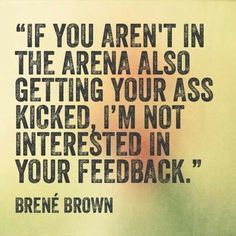
And we can be reminded by Brene Brown that “if you aren’t in the arena also getting your ass kicked, I am not interested in your feedback.”

86c68916622acfaedccc15747fb1ce91

Tell a better story

You sell a product that is losing out to Amazon on price and convenience? Stop chasing your tail in the pursuit of ever lower prices or fanciful plans to get into the same-day delivery business. Tell a better story; one rooted in deep customer relevance and remarkability.

You run a non-profit that has trouble getting the attention of large donors? Stop trotting out endless statistics and convoluted theories of change. Tell a better story, one that connects emotionally, paints a clear picture of a brighter future and inspires hope in a new and different way.

You see yourself as someone who has to do something to prove their worthiness? Stop repeating the false narrative of victimhood or original sin. Tell a better story, one that rejects the abusive programming from your childhood and one that embraces the gifts of imperfection.

I get it. Facts can’t diverge from an experienced reality forever. But far fewer things are actually facts than we tend to think. And besides, data without a soul, an inspiration or an ultimate hero, is often meaningless.

Imitation may be the sincerest form of flattery, but it’s a lousy strategy for just about everything.

You may feel like you have facts on your side, but hearts and minds (and wallets) rarely open up to the overwhelming force of logic.

The best way to claim our worthiness–to believe we are enough, we have enough and that we do enough-is to buy into the story until it rings true. Until it becomes habit.

People buy the story before they buy the product.

If nobody’s buying the product (even when that product is you) maybe the time you spend trying to be like everyone else0 or burnishing your PowerPoint would be better spent crafting a better story, believing in it and watching it spread.

A bunch of kids running toward a soccer ball

I was the coach of my first-born daughter’s soccer team when she was 5 years old. The coaching requirements, apparently, were lack of competing hobbies and near infinite patience. As it turns out lack of knowledge of the game and no discernible experience in coaching did not seem to matter.

If you’ve never seen a bunch of 5 year olds play soccer, it goes down pretty much like this. One of the kids kicks the ball and the rest start chasing it madly (except for that one girl who decides to stay back and get a jumpstart on her botany career). Once the scrum catches up to the ball, they all flail their legs a bit until, through luck or the kind of perseverance that will serve them well later in life, one of them makes contact and the ball squirts free. The cluster once again goes running after it with reckless abandon. This goes on for about an hour.

kids soccer

Now when I had some spare time from selling stuff nobody needs (I worked for a retailer) and my fellow coach wasn’t out saving lives or something far more noble (he’s a doctor), we both tried to learn a bit more about the game and how to coach it. So during practices and games we tried to impart some of our new-found wisdom.

We ran drills, we encouraged the actual playing of positions, we taught “strategy” and we yelled “spread out” until our voices sounded like Harvey Fierstein on a bad day. Our results were decidedly “mixed.”

I guess there was just something so new and exciting about the game and that ball that those kids just couldn’t resist chasing.

It was going to be some time before they learned the discipline to pace themselves.

It would take practice to appreciate that they were all in it together–and that by all of them trying to be the hero, the team was in fact being held back.

They would need more experience to learn that just because everyone else was running toward something didn’t mean it was right for them.

Eventually, they would come to see that impulse and enthusiasm is great, but so is awareness and discernment.

And hopefully they’d learn to pick up on the subtleties of metaphor.

Hanging around the edge of the pool

It’s pretty comfortable on the pool deck. We get to relax in a chaise lounge, soaking in the warm sun, taking in the scenery. Maybe somebody will even bring us a fruity drink with an umbrella in it.

It’s pretty comfortable being a consumer. It doesn’t take much energy to absorb while somebody else creates and produces; to catch while the other guy or gal pitches.

It’s pretty comfortable being a critic. Where’s the risk in pointing out the shortcomings of the innovator and the failings of the artist?

It’s pretty comfortable being a cheerleader. Not much chance of injury as we watch those in the arena from the sidelines and shout enthusiastic words of encouragement.

Of course nothing meaningful actually gets done through observation. Knowledge of a problem doesn’t solve the problem. Cheerleaders don’t win the game.

Let’s face it: there’s no shortage of people hanging around the edge of the pool.

What we need is more of us willing to take the plunge.

plunge

Gravity always wins

There are few forces more powerful than gravity.

And gravity never takes a day off. Or a minute for that matter. For all practical purposes it’s ever-present, strong and unrelenting.

Most of us have learned not to fight gravity for just these reasons.

From time to time we may want it to be different, but it’s not going to be.

So there’s absolutely no point in getting upset about it or worrying about it or strategizing on how to make it different. We accept it, work with it and get on with our lives never giving it much thought.

Of course gravity is hardly the only thing in our lives that’s not going to change despite our hopes, dreams, protestations, fears, manipulations, cogent arguments or ardent scheming.

The hard part is seeing that, accepting it and making a different choice.

klein_1015_2013_1_ricr-lo_-e1441730162800-1152x646

It’s easy to vote “no”

“Fear is a natural reaction to moving closer to the truth.” ~Pema Chodron

It’s rarely the case that organizations utterly lack new ideas or things to try. They just get voted down most of the time.

Many of us when confronted with change are quick to find fault with moving ahead. It might not work. We could look foolish. It just makes me uncomfortable. Maybe I’ll get fired. Best to just say ‘no.’

Most of us are filled with “should’s.” I should finish that novel or start that business. I should speak up more. I should finally make that trip. I should deal with the unfinished business with my family. And on and on. But our fear keeps us stuck and ‘no’ is all too often the seemingly safe choice.

Voting ‘yes’ more often isn’t the path of least resistance and it is far from a guarantee of success. Not everyone will get it, few may have your back and others might shun you entirely.

Stay the course. Be vulnerable. Chase remarkable.

Going out on a limb is where we’re needed, where we’re called to be, where the magic happens.

And your vote counts.

where-the-magic-happens

Shut up and play the hits!

Maybe you’ve been to the famous comedian’s show where by far the biggest laughs come from the bits you’ve already seen him do on Fallon. And Kimmel. And YouTube. And his five year old Netflix special.

Maybe you’ve excitedly gone to hear that marketing guru at a big industry conference and grown weary and uninterested when she begins by talking about her just released book, you know, the one you haven’t read. But you instantly light up again when she starts to riff on the ideas from a decade old tome that formed the basis of her TED talk that you’ve watched a half dozen times.

Maybe you’ve attended a concert by an iconic rock band and became impatient with the lead singer’s extended stage patter. And then as soon as they start to play the new stuff–or maybe some deep track from a classic album you’ve always skipped past–you know that’s your signal to head to the rest room or go grab a beer.

For any kind of artist–and we’re all artists now–it’s a whole lot easier to go for the well-tested laugh line, crank up the guaranteed crowd pleaser or simply default to the thing that made you popular (or at least accepted) in the first place. As it turns out, most of us like safety and there is safety in the familiar.

Organizations and brands aren’t a whole lot different. Most non-profits turn again and again to golf tournaments and galas to raise money. In the CPG  world, the core strategy is to churn out seemingly endless iterations of best sellers. And just about every retailer goes back to the well over and over again with minor tweaks to long-standing merchandising and marketing practices.

Yet the evidence is clear. Eventually we grow tired of the greatest hits. What worked well for so long, no longer does. And with more and more art and content and ideas and disruption being produced literally by the second–accessible to nearly everybody at any time, anywhere–what once seemed remarkable is anything but.

Is there an audience who only wants regurgitated versions of what you or your organization has always done, who can’t possibly accept new material, who has no interest in being challenged? Perhaps.

Is that the audience that’s going to get you where you need to be?

b5b5e8c767232b5f1425ce814f5713a2

A version of this post originally appeared at http://www.stevenpdennis.com  This blog is still in semi-stealth mode. New content will begin the week of September 12th.

Nobody pays attention at first

Many famous and influential artists toiled in obscurity for the majority of their lives. In fact, some only found celebrity and critical acclaim posthumously.

There are plenty of examples of great spiritual leaders–Siddhartha Gautama and Muhammad come to mind–whose messages were largely ignored early on. It took many years for them to develop anything that could remotely be described as a following.

Most great entrepreneurial ideas are hatched in privacy–or among a very small tribe of like-minded folks.

You’ve never heard of the band you’ll be obsessing over in a few years time.

The next great writer probably hasn’t even written her first book.

And guess what? That blog you’ve been thinking about starting for the last few months. Virtually–and maybe literally–no one is going to read your first post. Or your second. Or your third.

Much of the time we’re afraid to bring our ideas, our art, our passion to the world because we fear others judgment or ridicule.  Somehow, we tell ourselves–despite never  having practiced–were supposed to be good right out of the gate. So often our ego protection tells us to not even start.

But most of the time, in the beginning, nobody is paying attention. And if we believe this and embrace it it’s actually very good news.

Because nobody pays attention at first, we get to try things out, experiment, be vulnerable, push boundaries, fail better.

Because nobody pays attention at first, we can create free of the critics and the trolls.

Because nobody pays attention at first, we get to practice, for real, not just in our heads.

If we fight through the resistance, if we begin to develop a following, there will be plenty of time for second guessing and reacting to how the world meets us and our work.

But right now, enjoy the anonymity while you can. And just start.

172a21407b44cc8cf786f7f3cef0ca51

A version of this post originally appeared at http://www.stevenpdennis.com

What better time than now?

If you are anything like me, you might find yourself procrastinating from time to time. Or maybe even more often than not.

Maybe you tell yourself there is a perfect time to start that new project or to share that innovative idea with your boss.

Maybe you will update your resume and start looking for that new job once you get those few spare minutes that never quite seem to come.

Maybe you will start that diet once the Girl Scout Cookies are gone.

Maybe you will start living a life worth living in the morning.  Or after the weekend.

Maybe you will tell that person you love them when the moment is “right.”

After all, you are busy.

It’s taken me a long time to realize that there is no such thing as the perfect time or the right moment. Or to admit to myself that I’m always busy in some way.

If it’s important, it’s time to get started.

What better time than now?

17474f16314171ada9d1144c493a3dcc