The 2nd worst thing to ever happen to a politician in a theatre?

This past Friday, after a day of business in Manhattan, I found myself in the enviable position of having scored a ticket to the smash musical Hamilton. Once I settled into my seat, the collective excitement grew as the clock inched closer and closer to the 8pm showtime.

Then, from a portal to the right of the stage, Vice President Elect Mike Pence and his phalanx of Secret Service agents strolled in.

And the audience lost its mind.

To be sure, there was a solid minority that stood and applauded, but for the most part, Governor Pence was greeted with sustained boos, several “you sucks”, as well as other far less polite suggestions which, as far as I know, are anatomically impossible. Just as Pence and his entourage hit their seats it was lights out and on with the show.

During the performance the audience leaned in hard with raucous applause when Hamilton and Lafayette sang “immigrants we get the job done!” And King George seemed to throw major shade Pence’s way during “What comes next?”, looking towards him as he sang “when your people say they hate you, don’t come crawling back to me.” The show momentarily ground to a halt as the crowd’s hoops and hollers drowned out the action on the stage.

Good times.

By now, you have probably heard that during the curtain call Brandon Dixon Victor (the actor who plays Aaron Burr) directed a short admonition toward Pence as he tried to quickly make his way out of the theatre.

And then the internet lost its mind.

Being a very minor part of this weird little slice of history was both exciting and profoundly depressing. It WAS interesting and fun to have a front row (and rather expensive) seat to this unfolding drama. But the reaction of the crowd–and the wider world outside the theatre–only served to underscore how divided we are as a people and provided a harsh reminder that a radical shift in perspective and behavior is required if we are to avoid endless duels, many of which are certain to end badly.

So with apologies to Lin-Manuel Miranda, here is my version of the Ten Duel Commandments:

  1. If your skin is thin, stay out of the arena. There is such a thing as free speech. Don’t take everything personally. Learn the difference between hearing another’s truth and persecution or harassment. When in doubt, don’t post it on Twitter.
  2. Talk less, listen more. Our ego needs to be heard, to be right, to win. But projecting or amplifying our ego is the surest way to break connection. To build connection we must let the our “opponents” feel truly heard.
  3. Respect the other’s point of view. We don’t listen just to check it off our list. We listen to understand, to show respect, to challenge our own biases. But mostly to connect on a human level.
  4. There are few true enemies. Our perceived separation is not real. We truly are all in this together. I take no comfort from the hole being on your side of the boat. Most times it is our ego’s insecurity and isolation that causes us to create barriers and divisions that are not the least bit helpful. If there is a demon to be conquered it is most often our self-righteousness.
  5. Watch out for the belief test. When I find myself starting to decide whether I like or respect someone based upon whether they score well on my “good person” checklist all I know is I’m creating an us vs. them; I’m right, you’re wrong; I’m good, you’re bad, dynamic. That gives my ego a little hit, but it accomplishes nothing if I care about peace and progress.
  6. It’s okay to call bullshit. Just because we seek connection doesn’t mean facts aren’t a thing or that our strongly held beliefs don’t deserve being shared. Climate change is real, Obama was born in the United States, we really did land on the moon. Share THE truth and share your truth. Respectfully.
  7. Fear is a terrible engine and an even worse compass. There are times when fear keeps us from getting hurt or killed. However, most of the time our unconscious or irrational fear keeps us stuck in false beliefs that lead to self-flagellation, angry projection or both. If you are going to be dueling, best to understand your fear and not let it turn you into a bully or a heat-seeking missile. And if you can’t reasonably deal with your fear, best to take your finger off the trigger.
  8. Hyperbole is not the greatest thing ever. It’s hard enough to build connection when our fear is ruling the roost and when our differences are so pronounced and amplified. Stay grounded. Avoid catastrophizing and black & white thinking. When we go to extremes it tends to put others on the defensive. And the gap we need to close only widens.
  9. Put the hammer down. Lately it seems as if the only tool society has is a hammer and the nail we choose to hit over and over is the one that cuts the other side down. I’m hard pressed to find a time when that has worked. If you are are all about your ego and all about tearing down others, by all means keep swinging that hammer and keep pounding those nails. If you care about peace and progress, however, you might want to get some new tools.
  10. Rise up as necessary. On many issues, we must take sides. As Elie Wiesel reminds us “neutrality helps the oppressor, never the victim. Silence encourages the tormentor, never the tormented.” Seeking connection and following the other suggestions above does not mean rolling over in the face of intolerance, racism, homophobia or other forms of injustice or unacceptable behavior.

I’ll see you in the arena.

6361228227587199791522902720_tumblr_nwcwjlra5b1rno58uo1_500

h/t to Deepak Chopra

Misteaks were made

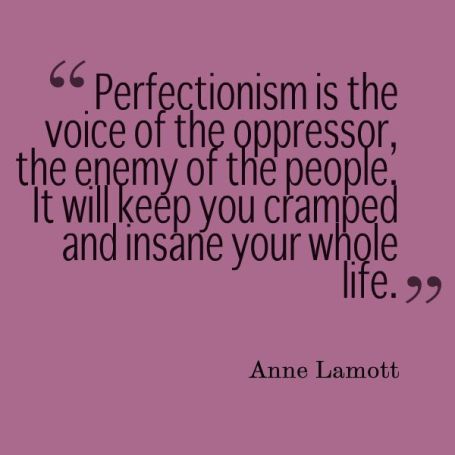
Our culture tends to reward perfectionism. Never say die, never fail, never let them see you sweat, be all you can be. And so on.

I’ve worked with–and for–a lot of perfectionists. Some of my best friends are perfectionists. I might have even fallen in love with a perfectionist or two. And, in the spirit of full disclosure, I’ve had my own bouts with setting impossibly high standards for myself and then falling short time and time again. Let the self flagellation begin!

It’s a trap.

In fact, more and more research suggests that perfectionism actually hampers success, while being a major contributor to depression, anxiety and even suicide.

Unfortunately, the growth of social media only exacerbates the situation and sets us up for a ridiculous game of comparison as our “friends” share all the fabulous things they are doing, all the great relationships they are in (“best boyfriend ever!”) and all the wonderful food they are enjoying (“nom”).

All these crazy comparisons only make us crazy. When we stop worrying about what others will think we are truly free to embrace being ourselves, warts and all.

Our fear of looking stupid or vulnerable hinders the possibility for intimacy. Letting go of our desire for control and certainty paves the way for real connection.

And it’s precisely our unwillingness to fail that is the biggest barrier to innovation (of all kinds) and personal growth. As Seth reminds us, “if failure is not option, neither is success.” Fear of failure, of making a mistake, keeps us stuck in so many ways.

Perfectionism is a curse.

Imperfection yields many gifts.

What do you say? Let’s go make some mistakes.

db5005d7ab5d5a73916f32b6b60b7b1d


The minor fall, the major lift

“It is not the weight you carry but how you carry it.”  – Mary Oliver

Somewhere along our path things aren’t going to go our way. And when the inevitable happens the effect can be anywhere from mere annoyance to outright devastation.

As we encounter a loss of any consequence–death, loss of physical or mental capacities, a job, our home, even a highly anticipated and hoped for future–grieving comes into play. And while we all experience grief differently, there is no going around it. We must go through it.

When we are early in a setback, big or small, if often seems like there is no way out. That all hope is lost.That no light can make it through the cracks.

If you are anything like I am it’s easy to minimize the pain and suffering that so many of us have endured or had thrust upon us. Often avoidance and denial can seem like the smartest way forward. That is, of course, until we turn to drinking or drugs or sex or shopping, or other forms of numbing, to escape from our harsh reality. It turns out that only makes things worse.

If I’ve learned anything from my sometimes torturous journey it’s that things are never as bad as they seem. Most falls, taken in the long view, are in fact minor. And it’s how we respond to them, carry them, how we lift ourselves and allow ourselves to be lifted by others, that ultimately makes the difference.

If you are reading this, the fact is you’ve survived everyone of your worst days and your worst moments.

This, too, shall pass.

We all have a lot of work to do.

Let’s get started.


Seeing around the corner

If very recent events tell us anything, polls, elaborate analyses and unbridled prognostication from “experts” only goes so far. Your best friend could be Nate Silver and you are still going to get a lot of stuff wrong.

It turns out nobody has a crystal ball or the perfect predictive model. We may have a pretty educated guess about what’s around the corner, but we are bound to be surprised–or even shocked–a fair amount of the time.

The truth is expectations so often suck the joy out of us.

Our fantasy of being in control undermines our happiness time and time again.

Fear of the future keeps us stuck.

Yet we shouldn’t conclude that we must gird ourselves for relentless disappointment or simply throw our hands up in despair as we are cast between the waves of the world’s events.

We only live in this present moment.

And as Shakespeare reminds us “there is nothing either good or bad, only thinking makes it so.”

Ultimately being on the path is to accept the things we cannot change, set our intention towards the things we can and, most importantly, find beauty in the unpredictability of this one precious life we’ve been given.


martin-luther-king-jr-i-have-decided-to-stick-with-love-hate-is-too-great-a-burden-to-bear-600x600


The votes we cast

Without question–in the United States at least–tomorrow is a huge day. The votes that are cast will set the tone for the level of discourse that will predominate for the next several years. The fundamental direction on key policies, and important things like the selection of Supreme Court Justices, will be solidified.

Many have argued that Presidents don’t really matter that much anyway. And that may well be true. Regardless, it’s almost certainly the case that even if the electorate does something truly idiotic most of us are likely to remain largely unaffected.

Nevertheless we work ourselves into a frenzy about the candidate we despise.

We vilify friends and colleagues who extol the virtues of the other guy (or gal).

We mock those who are “throwing away” their vote on a third party candidates.

And, in the greatest exercise of futility, we use social media as a weapon of persuasion.

Sidebar newsflash: More people have gone from being dog people to cat people because of something they have seen on Facebook than have been convinced to change their opinion on Trump or Clinton by anything you or I have shared.

What’s most interesting–and ultimately disturbing and disappointing–is that many of us will spend far more time, energy and social capital ruminating on an election that will likely not matter and on arguments that will make not a whit of difference than we will on the moment-to-moment decisions that clearly count and that we have a direct ability to influence.

We vote every day on being generous or stingy, kind or cruel, compassionate or indifferent.

We can embrace a world of possibilities or wall ourselves off in fear.

We can opt for acceptance or battle endlessly with reality.

We can choose a cycle of forgiveness or go down the path of revenge.

We have many opportunities everyday to decide which wolf to feed.

And here, without a doubt, our vote matters.


ddff85ed5f75314c24331b0dee4f66a9

h/t to the Rev. Dr. Daniel Kanter for his sermon that inspired this post.

The crazy cult of never giving up

Over the years I’ve noticed that a fair number of people subscribe to the notion that one should never ever give up.

While I employ a proactive thinning of my social media herd, I still encounter various motivational messages with a hashtag that essentially suggests that bailing on a project is the mark of the weak. That deciding to quit makes one a loser.

In fact, there is a whole sub-culture of authors and motivational speakers that extol the virtues of sticking with anything and everything we start with the dogged determination of a Kardashian seeking the media limelight. Just Google “never give up” and see what I mean.

Now I’m all for working hard and with determination. Grit and perseverance are surely desirable traits. But there is no question that giving up is often the absolute smartest thing we can do. Quitting is underrated.

If we value change we MUST deliberately choose to start things that we understand might not work. And that, by definition, means we begin knowing that quitting at some point is not only a real possibility but in many respects a desirable outcome, as it frees us up to pursue more productive and impactful paths.

If we subscribe to a strategy rooted in innovation, failure must be an option. While being unwilling to start in the first place is the biggest barrier to successful innovation, reluctance to give up on something that isn’t working is a close second.

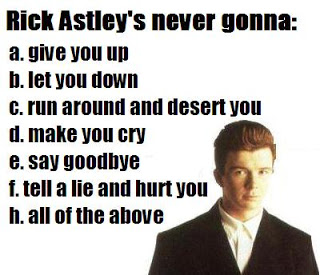
When we know that our goal is desirable and that our path is clearly the best one, by all means we should do the Rick Astley thing.

But if we are honest, we’ll discover that many times we are lying to ourselves and we are merely afraid to fold on a losing hand.


rick-astley


Get curious. Get proximate. 

If we’ve learned anything from this election cycle it’s that lots of people are long on opinions and short on facts.

We’ve also unearthed some curious theories.

That mere intelligence trumps actual experience. That promises to get tough are better than an actual plan. That most of success in life is about cutting “great deals, tremendous deals”. And that, when in doubt, let’s just let fear rule the roost.

Buy into these hypotheses and there are quite a few interesting things one is led to believe:

That those that have only flown over the battlefield know how to win the war.

That folks who have never suffered from institutional racism know exactly how to lift marginalized communities out of discrimination, poverty and violence.

That people who have won the ovarian lottery–and have likely never spent a minute walking in the shoes of those much less fortunate–can confidently say that “those people” just need to pull themselves up by their bootstraps.

Moreover, there is no need for further study, or to be even mildly inquisitive, because our minds are already made up.

It’s always easier to wage an air war, to be the critic, to shout encouragement from the stands. But then there’s that pesky little problem that it doesn’t really accomplish anything.

Much of the time, what we need–what I need–is to first get curious. Once we think we have all the answers there is a pretty good chance we’re wrong. A passionate curiosity releases us from ego and creates the potential for something far more spacious, real and connected. Most importantly, it gives us the information we need for good decision-making. It turns out facts matter.

The second step is to get proximate, to get out of our comfort zone and immerse ourselves not only in the facts, figures and issues, but the people, the emotion and, yes, our hearts.

As Bryan Stevenson reminds us “when people get proximate to the problems and the things they care most deeply about, not only does it help them do better work, be better problem solvers, I think it changes them.”

Yup.

curiousgeorge

h/t to Dr. Heather Hackmann for helping inspire this post.


The hardest to learn is the least complicated

Gentle reader, congratulations on your wise choice. It is indeed your good fortune to have chosen to read my blog today for I am about to reveal a short-list of virtually guaranteed ways for you to be successful in both your professional career and your personal life.

Intrigued? I bet.

Ready? Let’s do this.

Steve’s virtually sure-fire ways to be successful in your professional life:

  1. Focus relentlessly on the customer/client.
  2. Never engage in a price war you can’t win.
  3. Defy the sea of sameness and find your purple cow.
  4. Treat different customers differently.
  5. Reject the cult of busy.
  6. Don’t be afraid to fail: Fail better.

My virtually sure-fire ways to be successful in your personal life:

  1. Accept the things you cannot change.
  2. Live in the now; be present and mindful in all you do.
  3. Be kind whenever possible. It is always possible.
  4. Don’t take things personally.
  5. Remember the things for which you are grateful.
  6. Live open-heartedly and with compassion.
  7. Embrace vulnerability.

As a reader of this blog you have already revealed yourself to be a person of great intelligence and discernment, so you have likely already concluded that these ideas– collectively and individually–are both true and useful. More importantly, you probably noticed that they are all conceptually rather simple to comprehend.

So why do we struggle to put them into practice?

The first reason is our habits. If you are anything like me, you’ve been been conditioned to strive for perfection, to associate your self-worth with your job, your busyness and your possessions. Perhaps you’ve also been taught that vulnerability is weakness or that you’re not okay unless the people around you are okay or that it is your job to figure things out without the help of others. These are all rather obvious and destructive lies, yet our negative practice has created deep grooves in our psyche. The only antidote is to develop different habits and practice them until new grooves are formed.

The understanding is not the hard part. It’s the un-doing.

The second reason is our choices. I’ve watched myself (and more than a few friends, colleagues and loved ones) decide to stay stuck in the past, fight things I couldn’t change, drink the poison of resentment, bask in the misguided attention of victimhood and generally engage in far too much ego grasping and not enough letting go.

Again the understanding is not the hard part. It’s the acceptance that every day we start clean slated and I (and you my dear friend) get the chance to make a new set of choices. Our task is to choose wisely and to rinse and repeat.

The wolf we feed is the one that wins.


a8fa62506df7066665f3ae98b657547e

Does anger scale?

We live in an intensely angry world right now.

From the vast number of conflicts around the globe, to what we consider normal political discourse these days, to simple daily human interactions at work or on the road, so much of what we encounter is anchored in anger, drenched with hate.

We know that anger and frustration can be a catalyst, an accelerant, the fuel for action–big and small. And for me, anger most often comes in two forms.

It’s easy to see how anger at an unjust status quo calls us to action against systemic racism and related equity issues–or whatever the social impact issue might be. On the business front, there are countless stories of entrepreneurs creating new and better solutions to address areas of intense frustration. This first kind of anger, however motivated or pointed, is energizing and doesn’t involve a dangerous misalignment with ego. And it certainly doesn’t require hating or humiliating those who stand in opposition–or simply may not “get it.”

Then there is the anger of judgment, self-righteousness and one-upped-ness. The “I’m right, you’re wrong, and my ego is only going to be okay when I win and when I make you feel less than me (or even less than human).” We see this every day from Donald Trump and the “alt right“, from the road raging driver, from the religious zealot and, sometimes, in the day-to-day arguments with friends and loved ones. If I’m honest, I’ve been that guy more times than I care to think about.

This type of anger is rooted in fear. And fear rarely calls us to be our best selves. It often emerges from deep insecurity and generates a sense of false empowerment. It pushes people away. It makes connection impossible. It is devoid of compassion, generosity and basic humanity.

And it may work for awhile, but eventually it collapses under its own weight. And it certainly doesn’t–or shouldn’t–scale.

Bridges are better than walls. The bad driver is not going to change because I gave him the finger and leaned on the horn. I might feel better for a bit by “winning” the argument, but the possibility for lasting connection is lost and my reservoir of humanity is slowly drained.

In the battle between love and hate I know which side I’m taking.

Anger keeps us trapped, stuck, unconscious.

Love liberates.

manly-ministry

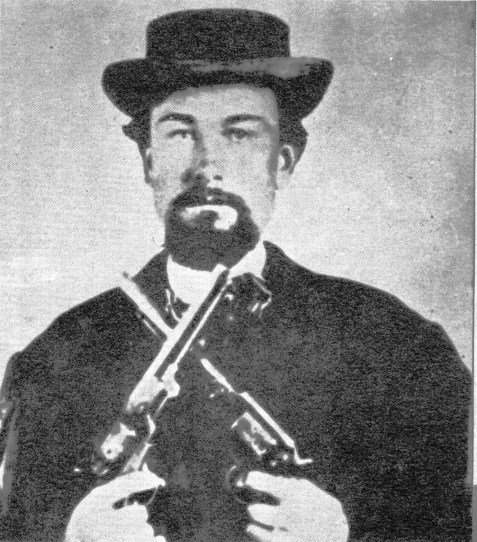
Just because you killed Jesse James . . .

“Just because you killed Jesse James, don’t make you Jesse James.”

– Mike Ehrmantraut to Walter White, Episode 3, Season 5 of Breaking Bad.

Just because you’ve attacked my idea doesn’t mean yours is better. Defending the status quo can be necessary, but mostly it’s an excuse to stay trapped in our fear.

Just because you sit in judgment of all the “idiot” drivers and “slothful” welfare recipients and “feckless” politicians, doesn’t actually do anything. Though your fragile ego may get a hit for a few seconds, putting others down isn’t a solution. And it certainly adds nothing to the level of discourse.

Shooting down something else isn’t remotely equivalent to creating something worthy or interesting. So instead of merely pontificating, let’s see your plan.

Being the critic is mostly a place to hide from the hard work of leading us to something new and meaningful. So instead of judging, let’s hear your ideas.

As Van Jones reminds us, Dr. King isn’t famous for saying “I have a complaint.”

It’s time to stop tearing down and to start building.

The universe is listening. And waiting.

jfd-1870s-guns-rev

A version of this post originally appeared at http://www.stevenpdennis.com